Independence Day
All World Gayatri Pariwar - also celebrate the National Festival commonly called as 15 august also.
History
The struggle for Indian independence began with the colonialization of India by Europeans. They came to India as traders but over the period of time they rose to power took control of Indian affairs. British occupied most parts of India whereas Portuguese and French also had their influence on few places The first uprising which is noted in the history of independence of India took place in 1857. This first war of Indian independence, was termed as a mutiny by the British.
Independence of India since inception can be seen in following steps.
- Regional movements prior to 1857, The Indian Rebellion of 1857
- Rise of organized movements - seventy-three Indian delegates met in Bombay in 1885 and founded the Indian National Congress.
- Rise of Indian nationalism - Congressmen saw themselves as loyalists, but wanted an active role in governing their own country, albeit as part of the Empire. This trend was personified by Dadabhai Naoroji, who went as far as contesting, successfully, an election to the British House of Commons, becoming its first Indian member.
- Partition of Bengal, World War I, Gandhi arrives in India, The Rowlatt Act and its aftermath - 1919
- The Non-cooperation movements, Purna Swaraj -1928, Salt March and Civil Disobedience -1930
- Elections and the Lahore resolution, The Indian National Army, Quit India
At the stroke of midnight, as India moved into August 15, 1947, Jawaharlal Nehru, India's first Prime Minister, read out the famous speech proclaiming India's independence.
"Long years ago we made a tryst with destiny, and now the time comes when we will redeem our pledge, not wholly or in full measure, but very substantially. At the stroke of the midnight hour, when the world sleeps, India will awake to life and freedom. A moment comes, which comes but rarely in history, when we step out from the old to the new, when an age ends and when the soul of a nation, long suppressed, finds utterance.... We end today a period of ill fortune, and India discovers herself again." - Jawaharlal Nehru (Speech on Indian Independence Day, 1947) Red Fort Ceremony
On the morning of August 15, the Prime Minister addresses the nation from the ramparts of the Red Fort in Delhi. In his speech, he highlights the achievements of the country during the past year and gives a call for further development. He also pays tribute to leaders of the freedom struggle at Amar Jawan Jyoti before flag hosting.
Flag Hoisting:
It is celebrated with flag hoisting ceremonies and cultural programs in the state capitals. The Prime Minister's speech at the Red Fort in Delhi is the major highlight.
All Government Organisations have a holiday as 15th August is a National holiday. In the capital New Delhi most of the Government Offices are lit up. In all the cities around the country the Flag Hoisting Ceremony is done by politicians belonging to that constituency.
In various private organisations also the Flag Hoisting Ceremony is carried out..
In almost all the schools and colleges around the country, no academic work in done on this day, but all the students and staff members are present on this day. Here flag hoisting ceremony takes place in the presence of the Principal / Head Master and singing of the National Anthem following various cultural activities performed.
Indian Flag:
Tricolor, the flag of India, is a representative of the independent Republic of India.
It was adopted as the national flag of India in its present form on July 22, 1947. Serving as the national flag of Dominion of India from 15th August 1947 to 25th January 1950, it thereafter became the national flag of the Indian Republic. First of all designed by Sister Nivedita in 1904.
Preamble of the Flag Code of India says that: "The significance of the colours and the chakra in the National Flag was amply described by Dr. S. Radhakrishnan in the Constituent Assembly which unanimously adopted the National Flag.
Dr. S. Radha Krishnan explained.
"Bhagwa or the saffron colour denotes renunciation of disinterestedness. Our leaders must be indifferent to material gains and dedicate themselves to their work."
"The white in the centre is light, the path of truth to guide our conduct."
"The green shows our relation to soil, our relation to the plant life here on which all other life depends."
"The Ashoka Wheel in the centre of the white is the wheel of the law of dharma. Truth or satya, dharma or virtue ought to be the controlling principles of those who work under this flag. Again, the wheel denotes motion. There is death in stagnation. There is life in movement. India should no more resist change, it must move and go forward. The wheel represents the dynamism of a peaceful change."
Important facts of National Flag of India names as tri-color.
* The ratio of the width of the flag to its length is 2:3
* The Indian flag is made up of just one fabric, Khadi.
* When the national flag is carried in a procession or parade, as per the Flag Code of India, it shall be on the marching right or in front of the center of the line, if there is a line of other flags.
* The flag cannot be used as clothing below the waist
Kite Flying
There is a tradition of flying kites in the National Capital Region on the Independence Day. The sky is dotted with hundreds of colorful kites and people engage in kite-flying competitions. Kites painted with the three colors of the national flag are a hot favorite. Balconies and roof-tops of houses are full of people flying kites and one can hear cheerful shouts like wo kata - wo kata of children in the evening as the kites soar in the sky.
India's Partition
In June 1947, Muslim League and the Congress Party decided to partition India along religious lines. Thus under the provision of the Indian Independence Act, two separate nations, India and Pakistan were born. While India received most of the scattered polities or princely states, Pakistan received the remaining western part and the Muslim dominated eastern region which was known as East Pakistan now Bangladesh.
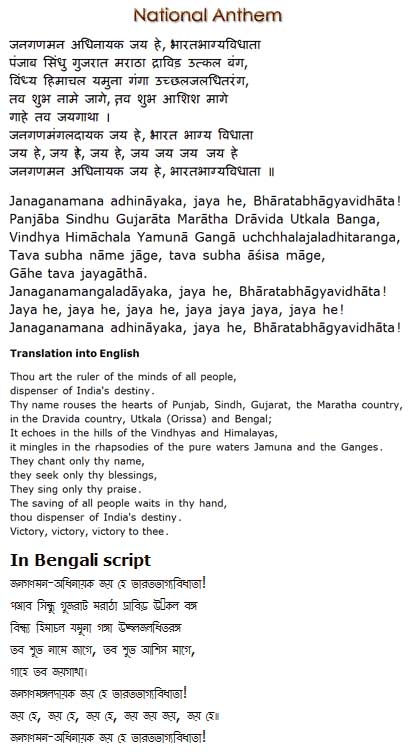
National Anthem